 ®
® LASER hair removal.
Long-term reduction of unwanted hair on the face and body — with a Sciton-platform laser, conservative protocols, and a treatment series tuned to the area you are treating.
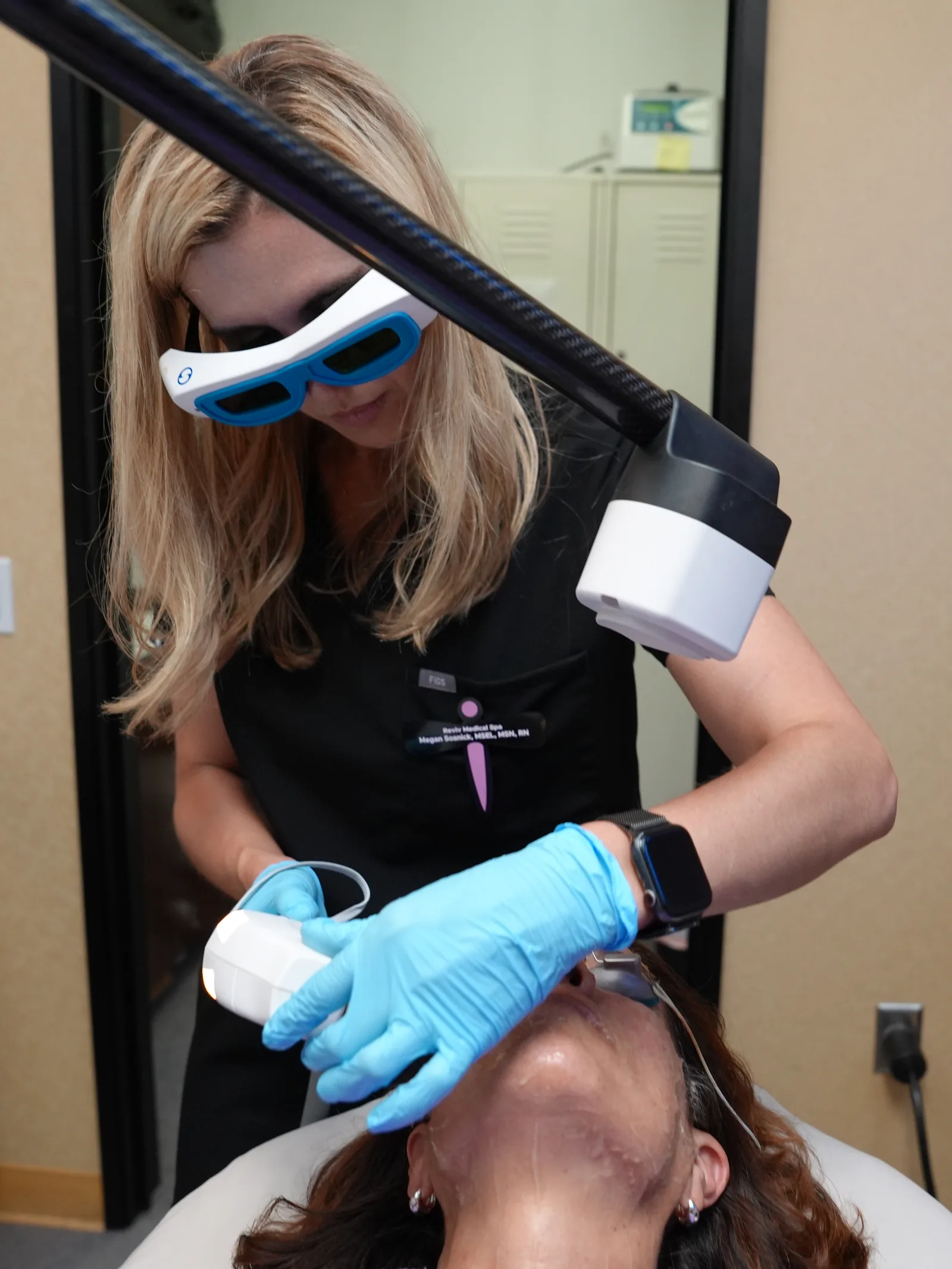
Targeted light, quieter follicles.
Laser hair removal uses pulsed light energy to heat the melanin in the hair shaft. That heat travels down to the follicle and disables it from producing future hair. The skin around the follicle is largely untouched — the laser is tuned to the wavelengths that pigment absorbs.
It is a permanent reduction, not permanent removal. Most patients see 70–90% of treated hair go away after a full series, with the remaining hairs finer and lighter than before. Periodic maintenance sessions keep the result stable.
The treatment is performed in a series because each pass only catches the hairs in the active growth phase. A typical course is 6–10 sessions spaced 4–8 weeks apart, with the cadence depending on the body area you are treating.
A Sciton platform, a careful screen.
At Reviv Med Spa in Millbrae, laser hair removal is performed by our Aesthetic Nurse Megan Sosnick, RN, with all device settings and treatment protocols approved by our Medical Director Dr. Gayle Misle, MD. Every consultation starts with a face-to-face skin and hair assessment — we look at your hair color, hair density, skin tone, sun history, and medical history before we ever fire the laser.
Reviv runs on the Sciton laser platform — the same family of devices behind our BBL photofacial and Halo skin-resurfacing programs. Settings are customized for each patient based on:
- Hair color & thickness melanin target
- Darker, coarser hair absorbs the most energy. Very blonde, gray, white, or fine red hair responds less reliably — we will tell you honestly at consultation.
- Skin tone safety profile
- Modern lasers are safe across most skin types when settings are properly adjusted. We screen your skin type and customize the device parameters for your case.
- Treatment area cycle & cadence
- Face cycles faster (4–6 weeks between sessions); legs and back are slower (6–8 weeks). The area determines your treatment rhythm.
- Sun exposure history screening question
- Recent tans, self-tanner, and active sun exposure all change melanin levels in the skin. We require at least 4 weeks of sun avoidance before each session.
Treatment day takes 15–60 minutes depending on the area. Skin cooling is built into the handpiece; we add cool air or topical numbing for sensitive areas. Most patients describe the sensation as a brief snap or warm pinch.
You will see treated hairs shed naturally over 1–2 weeks. Do not pluck or wax during the series — only shave. The follicle needs to be intact for the next session to work.
Face to body, head to toe.
In your consultation we will identify which areas matter most for your goals and budget. Most patients start with one or two priority areas and add others over time.
Upper lip & chin
Fine facial hair on the upper lip, chin, and jawline. Lower-energy passes for the face.
Underarms
One of the fastest treatment areas. Most patients see noticeable reduction in 4–6 sessions.
Bikini line / Brazilian
From basic bikini line to full Brazilian. Conservative settings, careful technique.
Legs (full or lower)
Lower legs, full legs, or thighs. Larger area, longer session — typically 45–60 min.
Arms (full or lower)
Lower arms, full arms, or hands and fingers. Quick to treat.
Chest
Chest hair removal for men or fine chest hair for women.
Back & shoulders
Full back, upper back, or shoulders. Sessions typically 30–45 min.
Neck
Front of neck (men) or back-of-neck stray hairs (women).
The reasons patients book.
Unwanted facial hair
Upper lip, chin, sideburns, and jawline. Common reasons include hormonal changes, hereditary patterns, and PCOS-related growth.
Body hair maintenance
Underarms, bikini line, legs, and arms. The areas where shaving, waxing, and depilatories become a daily or weekly burden.
Ingrown hair / razor burn
Patients with persistent ingrowns or shaving irritation often get the most quality-of-life improvement from laser.
Pseudofolliculitis barbae
Recurrent neck and beard-area ingrowns in men. Laser can substantially reduce frequency and severity.
PCOS-related hirsutism
Hair growth driven by hormonal imbalance. Laser is a reasonable adjunct to medical management — discuss with your physician.
Legs Bikini Brazilian Upper lip Chin Back Chest Underarms Legs Bikini Brazilian Upper lip Chin Back Chest Underarms Legs Bikini Brazilian Upper lip Chin Back Chest What to know, in four lines.
- 01
Laser hair removal is a permanent reduction — not permanent removal. Most patients see 70–90% reduction after a full series, with periodic maintenance sessions to keep results stable.
- 02
It works on actively-growing hair only. That is why a series of 6–10 sessions spaced 4–8 weeks apart is needed: each session catches a different cohort of hairs in the active phase.
- 03
Hair color matters more than skin color. Laser targets melanin in the hair shaft — it works most reliably on dark, coarse hair. Very blonde, gray, or red hair responds less predictably.
- 04
Pricing depends on the area and the size of the area. We quote in writing at consultation, and we package multi-session series so per-session cost is lower.
From day zero, to your next session.
Treatment day. 15–60 min depending on area. No anesthesia. Mild sting like a rubber band; cooling tip and cool air keep it comfortable.
Mild pinkness around hair follicles is normal — looks like a soft sunburn. Resolves on its own within 24–48 hours. Avoid hot showers, saunas, and direct sun.
Treated hairs shed naturally. Do not pluck or wax — only shave. The follicles are still releasing the dead hair shafts.
New hair growth from a different cohort begins to surface. This is the cue for your next session. We schedule on the rhythm your area requires.
Before your visit, and the days after.
- Schedule a Consultation
- We will discuss your goals, medical history, and any concerns. Disclose any medications or supplements you are taking, as some can increase the risk of bruising.
- Avoid Sun Exposure
- Avoid sun exposure and tanning (including self-tanners) for at least 4-6 weeks before your treatment. Sunburned or tanned skin can increase the risk of complications and may make the treatment less effective.
- No Waxing, Plucking, or Electrolysis
- Refrain from waxing, plucking, or electrolysis for at least 4-6 weeks prior to your treatment. These methods temporarily remove the hair follicle, which is needed for the laser to target.
- Shave the Treatment Area
- Shave the treatment area 24-48 hours before your appointment. This ensures the laser can target the hair follicle effectively while minimizing the risk of surface burns.
- Avoid Certain Skincare Products
- Discontinue the use of retinoids, glycolic acid, and other exfoliating or irritating skincare products on the treatment area for at least one week before your appointment.
- Avoid Blood-Thinning Medications
- Discontinue use of blood-thinning medications and supplements such as aspirin, ibuprofen, fish oil, vitamin E, garlic, ginseng, and ginkgo biloba at least one week before the procedure. Always consult with your primary care physician before stopping any prescribed medications.
- Clean Skin
- Arrive at your appointment with clean, dry skin. Avoid applying lotions, creams, deodorants, or makeup to the treatment area on the day of your appointment.
- Stay Hydrated
- Drink plenty of water in the days leading up to your treatment to ensure your skin is well-hydrated, which can help with recovery and results.
- Avoid Sun Exposure
- Avoid direct sun exposure and tanning (including self-tanners) for at least 4-6 weeks after your treatment. Use a high-SPF sunscreen to protect the treated area from UV damage.
- Avoid Heat Exposure
- Refrain from hot showers, saunas, hot tubs, and vigorous exercise for at least 24-48 hours post-treatment to prevent increased irritation and swelling.
- Gentle Cleansing
- Cleanse the treated area gently with a mild, non-abrasive cleanser. Avoid using any harsh skincare products or exfoliants for at least 48 hours.
- No Waxing, Plucking, or Electrolysis
- Do not wax, pluck, or use electrolysis on the treated area between sessions. Shaving is allowed, as it does not remove the hair follicle.
- Avoid Tight Clothing
- Wear loose, comfortable clothing to prevent friction and irritation on the treated area.
- Moisturize
- Keep the treated area well-moisturized with a gentle, non-irritating lotion to promote healing and comfort.
- Avoid Blood-Thinning Medications
- Continue to avoid blood-thinning medications and supplements for at least 24-48 hours post-treatment to minimize the risk of bruising.
- Monitor for Side Effects
- Mild redness, swelling, or itching at the treatment site is normal. However, if you experience severe pain, blistering, or other concerning symptoms, contact your medical provider immediately.
- Follow-Up Treatments
- Schedule follow-up treatments as recommended by your provider. Laser hair removal typically requires multiple sessions for optimal results.
- Avoid Makeup (if applicable)
- Avoid applying makeup to the treated area for at least 24 hours, especially if the face was treated. If necessary, use mineral makeup that is gentle on the skin.
You'll receive these laser hair removal instructions in writing before your visit and we review them with you in person. Questions during recovery? Call (650) 697-3339 — we answer same-day. See the aftercare hub for the universal recovery principles and when to call us.
What it actually costs.
Laser hair removal at Reviv starts at $53 per session for the smallest area (ears) and scales up with the area treated. Pricing depends on the area and the size of the area — underarms cost less than legs; lower legs cost less than full legs; face costs less than back. We quote in writing at consultation, before any treatment begins, and we offer multi-session packages so per-session cost is lower than buying sessions one at a time.
Who it's for — and who it isn't.
- Adults with dark, coarse hair and a goal of long-term reduction
- Patients tired of shaving, waxing, depilatories, or threading on a regular cadence
- Patients with recurring ingrown hairs, razor burn, or pseudofolliculitis
- Patients with PCOS-related facial hair growth (with primary medical management in place)
- Pregnant or breastfeeding patients
- Patients with very blonde, gray, white, or fine red hair (laser targets melanin — these respond less reliably)
- Patients with a recent tan or planning sun exposure during the treatment series
- Patients on photosensitizing medications (e.g., recent isotretinoin) — we screen at consultation
Your laser team.

Dr. Gayle Misle, MD
Founder of Reviv Med Spa & Laser Treatment. Anesthesiologist by training; oversees our laser program and approves all device settings and treatment protocols.

Megan Sosnick, RN
Aesthetic Nurse and Practice Manager. Performs laser hair removal sessions and manages your treatment series — from first consultation to final maintenance pass.
Real Reviv patients. No retouching.
Same lighting, same pose, same camera. Tap any pair to read the case study — area treated, sessions completed, hair color and skin type.
Individual results vary. All photos are real Reviv patients, shared with consent. Lighting and pose are matched, no retouching.
What people say about Reviv.
…I have been coming to see Megan for my laser hair removal — she is beyond kind, so gentle and always has great recommendations while looking out for me and my skin. I love coming to see everyone and spending my time in the perfect oasis they have curated at Reviv. Thank you!
I visited this office on several occasions for the laser hair removal procedures. Dr. Misle and her staff always treated me with respect and I was always satisfied with the results. I recommend this office.
I've been to Reviv 3 times now & am having Laser Hair removal done. I am very happy with the results so far. They got a new machine in the summer & it is very fast & efficient. I have legs, underarms & bikini done & I am in & out in 45 minutes relatively pain free.…
Frequently asked.
How many laser hair removal sessions will I need?
Most patients need 6–10 sessions to reach their goal, spaced 4–8 weeks apart depending on the body area. Face cycles faster (4–6 weeks), legs and back are slower (6–8 weeks). After the initial series, periodic maintenance sessions every 6–12 months keep the result stable.
Does laser hair removal hurt?
Most patients describe it as a brief snap or warm pinch — a 2–4 out of 10 in most areas. The sensitive areas (upper lip, bikini line) are sharper but still tolerable. Our laser has built-in skin cooling that takes the edge off; we use cool air or topical numbing for sensitive areas if you prefer.
Is laser hair removal permanent?
Laser hair removal is a permanent reduction — typically 70–90% of treated hair will not grow back. The remaining hair is usually finer and lighter. Hormonal shifts (pregnancy, perimenopause, PCOS flares) can stimulate new growth in previously-untreated follicles, which is why most patients return for periodic maintenance sessions.
Does laser hair removal work on all skin types?
Modern lasers are safe across most skin types when settings are properly adjusted. We screen your skin type and hair color at consultation and customize the device settings for your case. Patients with very deep skin tones need a specialized wavelength — we will tell you honestly at consultation if our equipment is the right fit.
Why does it not work on blonde or gray hair?
Laser targets melanin, the dark pigment in the hair shaft. Very blonde, gray, white, or fine red hair has too little melanin for the laser to lock onto. We will assess your hair color at consultation and tell you honestly whether laser is the right tool for you.
How much does laser hair removal cost?
Pricing starts at $53 per session for the smallest area (ears), then depends on the area treated and the size of the area — underarms cost less than legs; lower legs cost less than full legs. We quote in writing at consultation and offer multi-session packages so per-session cost is lower than buying sessions one at a time.
Can I tan before or during my laser series?
No — please avoid sun exposure and self-tanner for at least 4 weeks before each session. Tanned skin contains extra melanin, which competes with the hair for the laser energy and increases the risk of burns or pigment changes. Use SPF 30+ daily during the series.
Should I shave or wax before my session?
Shave 24 hours before your session, and do not wax, pluck, or use depilatory creams during the entire treatment series. The laser needs the hair root intact in the follicle to work — waxing removes the root and resets the cycle.
Are there side effects?
Most patients see mild pinkness around the follicles for 24–48 hours, similar to a soft sunburn. Rare side effects include temporary blistering, pigment changes, or scarring — almost always related to sun exposure or improper settings. We screen carefully and start conservative.
Who should not get laser hair removal?
Patients who are pregnant, have a recent tan, are on photosensitizing medications (including recent isotretinoin), or have certain skin conditions. We screen at consultation. Patients with very blonde, gray, or fine red hair are not good candidates regardless — laser needs pigment to work.
Patients come to us from across the peninsula.
Reviv Med Spa is at 31 S El Camino Real in Millbrae, California — easy to reach from across the Bay Area peninsula. Patients come to us from Burlingame, San Mateo, Hillsborough, San Bruno, Foster City, and the broader peninsula including Atherton, Belmont, Brisbane, Daly City, Half Moon Bay, Menlo Park, Pacifica, Palo Alto, Portola Valley, Redwood City, San Carlos, and South San Francisco. Off the 101, just south of SFO. Free parking on site.